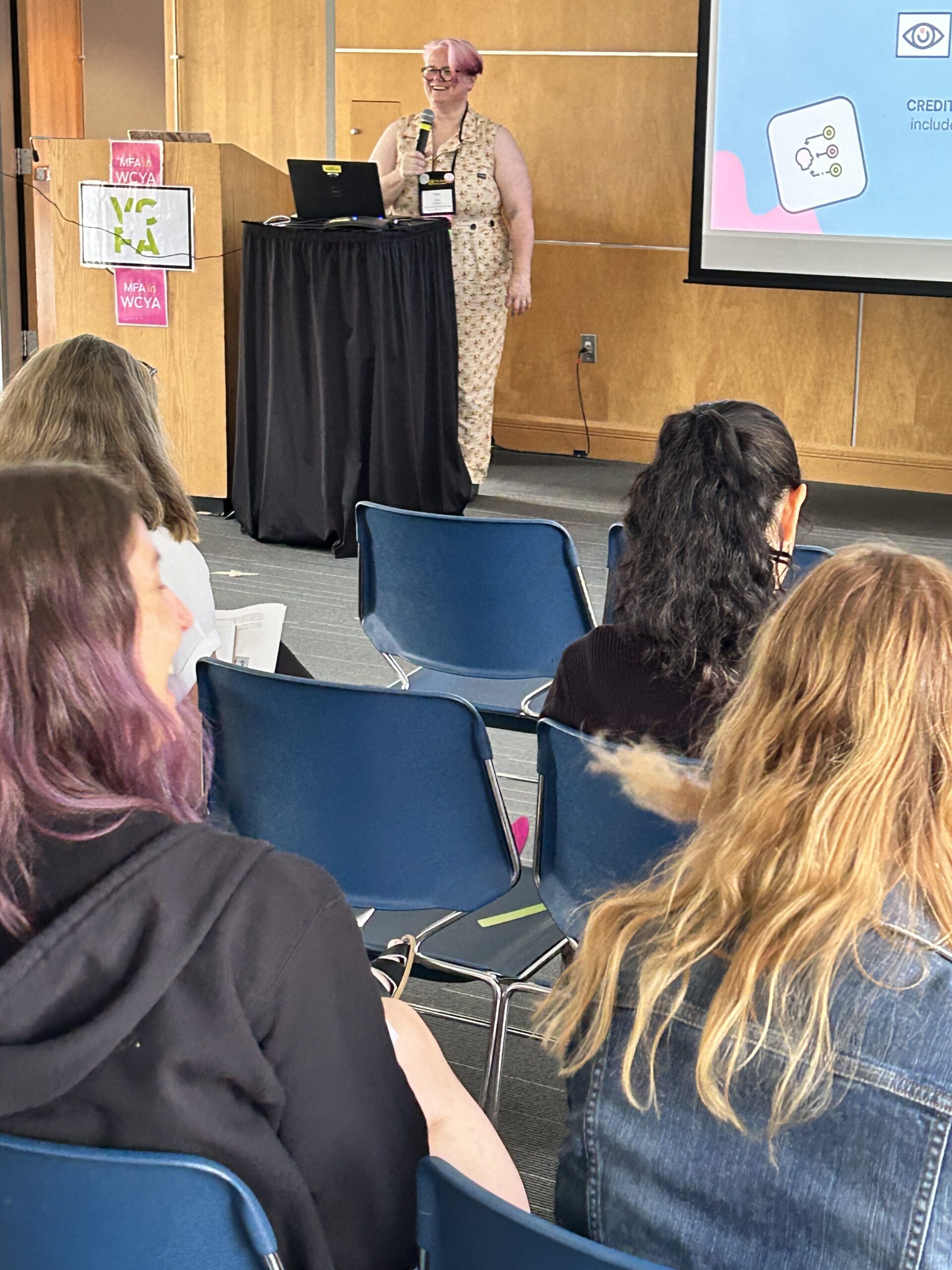
Hey everybody. For your information, there are a couple of places I am going to be soon.

Saturday, 9/27: Portland KidLit. Hurray for conveniently located conferences!

And next weekend, 10/4-10/5, considerably less convenient, but very exciting, since it will be my first time attending: the Small Press Expo!

In both cases I will as usual have books and comics and stickers. I might even have a copy or two of Comic Book Tattoo, although it is a weighty enough item almost to mean an extra luggage charge all by itself.

It may surprise those of you who know me in real life to learn how long it took me to finish TechGnosis: myth, magic, and mysticism in the Age of Information by Erik Davis. Over a month, with many books in between.

Not because I wasn’t enjoying it, not because it’s impenetrable or boring, but because it’s dense. I’d read a section and then have to let it sink in for a while, as though my brain was rewiring itself.

That metaphor I just used, comparing my brain to a machine with wiring? (Huh, doesn’t my brain have wifi yet? I need to upgrade…) It’s a small example of the sort of phenomena that Davis explores in TechGnosis; the human tendency to describe the mysterious in terms that derive from technology, whether the technology in question is a scroll or a scroll bar. I’ll let him explain in more detail:

Human beings have been cyborgs from year zero. It is our lot to live in societies that invent tools that shape society and the individuals in it. For millennia, people not so dissimilar to ourselves have constructed and manipulated powerful and impressive technologies, including information technologies, and these tools and techniques have woven themselves into the social fabric of the world. Though technology has only come to dominate and define society within the lifetimes of a handful of human generations, the basic equation remains true for the whole nomadic trek of homo faber: Culture is technoculture.

Technologies concretely embody our ability to discover and exploit natural laws through the exercise of reason. But why do we choose to exploit certain natural laws? In what manner and toward what ends? Though we may think of technology as a tool defined by pragmatic and utilitarian concerns alone, human motivations in the matter of technology are rarely so straightforward. Like the rationality we carry within our minds, whose logical convictions must make their way through the brawling, boozing cabaret of the psyche, technologies are shaped and constrained by the warp and woof of culture, with its own peculiar myths, dreams, cruelties, and hungers. The immense machineries of war or entertainment can hardly be said to proceed from rational necessity, however precise their implementation; instead, we find their blueprints inked upon the fiery human heart.

Clarke’s Third Law, says Davis much later in the text, is “a quip that deserves more scrutiny than it usually receives.” Our ideas about magic and technology are inextricably linked; you can’t remove the soul from the new machine.

TechGnosis resists a quick and easy summary. It’s not a fast read, but if you’re interested in magic, myth, technology, and their intersections, I think you’ll find it as rewarding as I did.

You know the one: Take a picture of yourself right now. Don’t change your clothes. Don’t fix your hair. Just take a picture. Post that picture with no editing. (Except maybe to get the image size down to something reasonable. Don’t go posting an eight megapixel image.) Include these instructions.

for the "unedited self" meme

Snag, filed
Important filez are important.

Snag, defending territory
NOOO they be stealin my filez!

Perhaps it’s just immediate post-viewing hyperbole, but I think Burn After Reading is my favorite Cohen brothers movie so far.

The trailer emphasizes schtick, and there’s certainly schtick in abundance, but if that’s all you see when you watch this movie, you’re missing a lot. It’s about how we construct our realities based upon our understanding of how the world works. It’s about lies, and the processes by which lies are found out, or not. It’s about how the act of interpretation creates meaning and imposes a narrative on events, even if the interpretation is wildly off. It’s hilarious and brutal, bleak but somehow uplifting in the midst of the bleakness, because it so clearly shows the murk we’re in.

It’s also an outstanding parody of espionage thrillers, from the over-the-top music to the paranoid cinematography to the dour (and bemused) Russians to the familiar lines of dialogue: “Who do you work for? Who do you work for?

Who do you work for? And how does that lens color your notion of what’s going on?

These sidewalks aren’t far from each other.

Your existence gives me hope

Sellouts

Do you know, Portlanders, that there is an I-205 bike path? I discovered it today and felt that I had learned one of the city’s secrets.

I rode along, saying “On your left, pardon me, thank you” to the occasional pedestrians who looked a bit surprised that a cyclist was actually using the path, listening to the nearby traffic, feeling smug and empowered.

That feeling only intensified when I got back relatively close to home — Grant Park — and discovered that, it being Friday night at the beginning of the school year, there was a football game going on, and the band was playing.

They were playing this**:

(Okay, they didn’t have three cellos and a full orchestra. But it sounded pretty sweet from a marching band, too.)

…that I am avoiding campaign coverage like it was a pledge drive. Which it kind of is, I guess.

Instead, Portlanders, I would like to recommend a presidential restaurant: Lincoln. It is a little fancy but sometimes you can be a little fancy. But you do not have to dress fancy because if you did we would be in some other city.

lincoln

I ordered two things on the menu that included mizuna — squash salad and Oregon albacore — though I did not know what mizuna was. Answer: a green. Slightly bitter, delicious. Also delicious, but without mizuna: chocolate espresso cake with Maldon salt. Mm, salt.

When I get home from a trip and go through the accumulated mail, usually it is not that exciting. Bills, catalogs, credit card offers…wait.

What’s this?

It’s from Literary Arts?

Oh. My.

The Rules for Hearts is a finalist for an Oregon Book Award! And I’m in great company in the YA category:

Bonus news: In the Loud issue of Bitch Magazine (I love their themes), I’m one of five authors interviewed about our influences and why this is a golden age of YA fiction. Discover my shocking reaction to Judy Blume’s Forever and in which author’s world I wrote fanfic! (Longtime readers may know the answer to the second…)

Extra bonus news: The aforementioned Bitch Magazine is having a release party for the aforementioned Loud issue this Wednesday, September 10th, at 7 pm at In Other Words Women’s Books and Resources. I’m planning on going — Portlanders, see you there?

Details from the facade of what used to be the YMCA building in downtown Newark, Ohio:

Related Posts