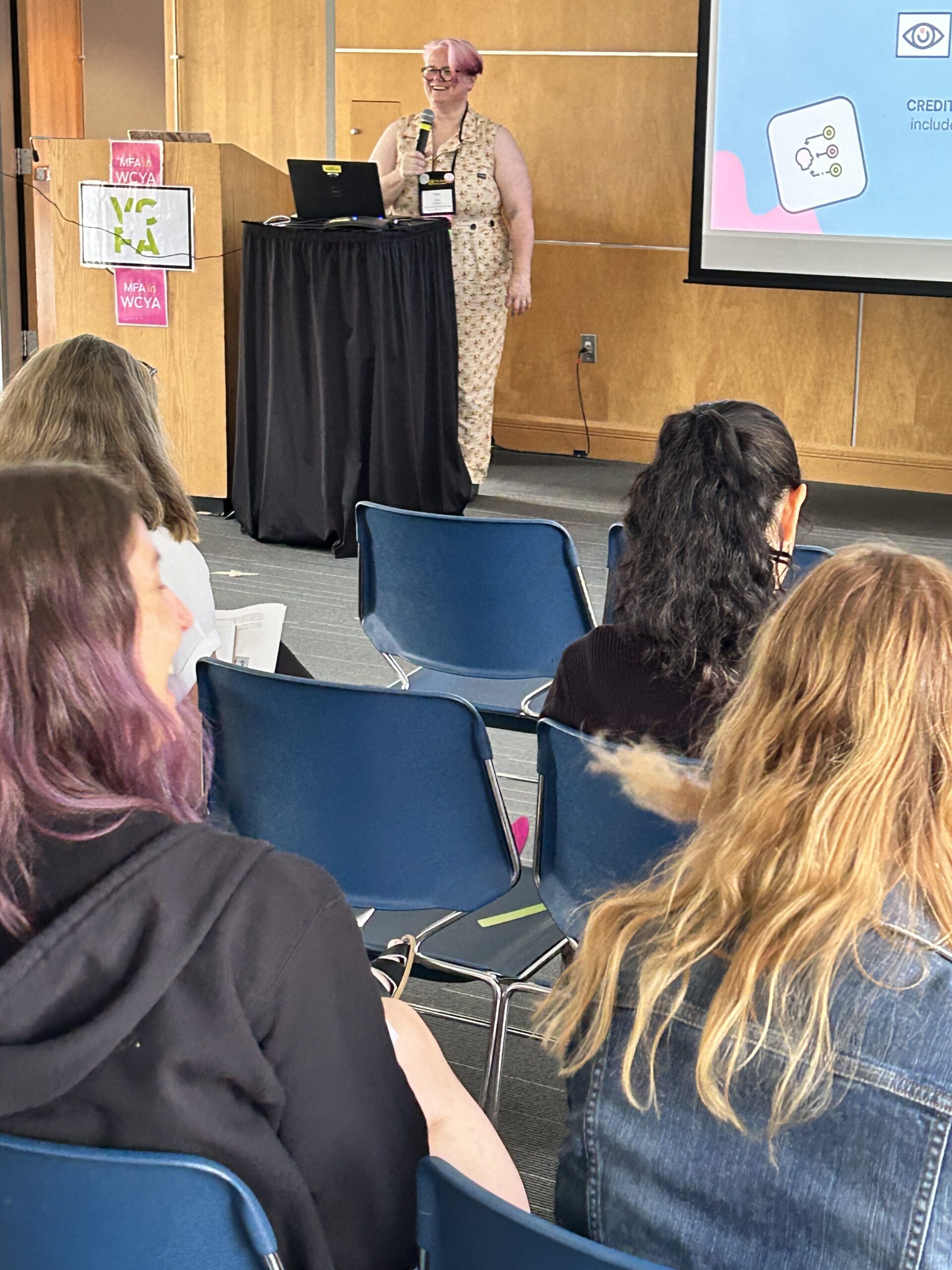
Tonight I went to see April Henry talk about her latest books at Powell’s. Yes, that’s books, plural — Girl, Stolen; The Night She Disappeared, and Eyes of Justice. I am in awe not just of how quickly she can write, but how frequently she thinks of gripping plot ideas — including the premise for her new series, that I can’t tell you about, but of which I am, full disclosure, totally jealous.

At any point, April is usually dividing her attention between six different books; writing two, editing two, promoting two. She writes both teens and adult books, but says there’s no difference in her approach except that the teen titles are shorter. Someone asked if she worries about keeping up to date with today’s teens. She does do some research, but  ”Teens in my books are usually running for their lives, not thinking about their prom dates.”

If April is doing an event in your town, you should totally go. You should also ask a question, because when you do, she will throw you chocolate.


In the eleven (!) years since my first book was published, I’ve become more reticent about blogging about my work in progress. Deadlines shift. Publishing dates change. Difficult events erupt and occupy all mental bandwidth.

I never want to be in the position of cheerily announcing that things are going super awesome with my fabulous new project, and then find myself wishing I could scrub the post from the Internet’s memory when something about said project goes sideways.

And yet, when it’s been a while since I’ve mentioned here that my work in progress does in fact exist, I become anxious. People will think I’m not doing anything. (Which people are these, exactly? Oh, you know. The ones whose job it is to judge me.)

Or I’ll get an email from a fan asking if I’m ever going to write any more books, sometimes with quite specific suggestions about what I should write next. And while I should feel grateful and pleased that a reader wants new books from me, I more often feel sad and guilty that I can’t immediately produce said books, made to order like gourmet sandwiches.

Which is dumb, and probably I should just shake it off, right?

Instead I’m writing this to tell you that what you don’t see in my posts is not simply the anxiety and guilt described above, but the slow accumulation of words that means, eventually, there will be more books. Dammit.


Things I am doing, an incomplete selection:

  • Making oatmeal with a lot of stuff in it. Tips: toast the pecans before you chop them. Use frozen blueberries when fresh ones are out of season. Frozen banana works too, and is actually great with the toasted pecan. Do not stint on the cinnamon.
  • Working on my works in progress  in longhand, to see if the different feel of pen on paper will make my brain go different places than it does with fingers on keyboard while grimacing at glaring screen.
  • Reading A Different Shade of Blue: how women changed the face of police work, by Adam Eisenberg. Specifically, it’s about the history of women in the Seattle Police Department. Really interesting perspectives on the changing role of female cops and the discrimination they’ve dealt with over the years, sometimes compounded and complicated by prejudice based on their ethnic & cultural backgrounds and/or sexuality.
  • Listening to The Modern Scholar: The Second Oldest Profession, Part 1: A World History of Espionage by Jeffrey Burds. A line I liked, on the complexity of managing/handling spies: “Rare indeed is the field agent who is a mere executor of his master’s will.”
  • Pondering how not to be a clever writer.

…by Sylvia Townsend Warner, as a result of this article. I am loving it, the prose and the mood. Here is a quote from it that reminds me a bit of Tove Jansson:

 Her mind was groping after something that eluded her experience, a something that was shadowy and menacing and yet in some way congenial; a something that lurked in waste places, that was hinted at by the sound of water gurgling through deep channels and by the voices of birds of ill-omen. Loneliness, dreariness, aptness for arousing a sense of fear, a kind of ungodly hallowedness—these were the things that called her thoughts away from the comfortable fireside.

No empty trips. A casual search suggests that this advice has its origins in the restaurant industry. Save time by consolidating. When you’re bringing the drinks for table two, if you’ve got room on the tray, get the calamari to table three. On your way back to the kitchen, grab the empty glasses from table four, those lushes.

I can’t remember when I first heard the phrase, but now I often hear it in my head. I come home, go upstairs with my bag full of sweaty gym clothes, toss them into the laundry basket. No empty trips whispers my brain. So I pack the now-empty gym bag for the next day and take it back downstairs. If I’m really on it, on my way back out I take out the trash, stopping at the car to throw the gym bag in the trunk. (Thus far I’ve managed to avoid putting the gym bag in the trash and the trash in the trunk, but sometimes it’s a struggle.)

I also think about it when I write. Say I have to get the protagonist from point A to point B. What can she be doing on the way that reveals more about who she is? “Put something into your character’s hands,” Franny Billingsley once advised. No empty trips.

I’m trying to figure out whether to write an as-yet-unformed narrative as prose or as the script for a graphic novel.

Prose Pros:

– Control. Being totally in charge of the world I’m creating.

– Being free to write about things that are hard to draw without fear that I’ll eventually make an artist’s life hell.

Prose Cons:

– I can’t use silent pages, which can be a great way to create breathing space for a reader and convey moods.

– I can’t use the kind of narrative counterpoint that I love so much in comics, when the pictures convey something different from and perhaps in opposition to the text.

Graphic Novel Pros:

– Collaboration. Getting the insight and talent of another creator.

– A graphic novel script doesn’t take as long to write as a novel.

Graphic Novel Cons:

– The script might not take as long to write, but I still have to wait for the artist to draw it, and the artist almost certainly has other projects competing for their time.

– There are still a lot of readers out there who don’t speak the language of graphic novels, who aren’t confident in their ability to parse panels, or are just disinclined to make the effort.

How am I going to decide? I don’t know.

I can already visualize certain scenes very clearly. But does that mean the scenes will be most effective as comics, or that I simply need to convey them as clearly in prose as I’m seeing them in my head?

Other writers of both comics and prose, how do you decide which format is best for a particular story?


I almost didn’t go to yoga. It’s a late class, it doesn’t start til 8:30 pm. I’d already had a long day, hadn’t slept well last night. But I managed to convince myself to leave the house because I wanted for damn sure to relax.

Another class ends just before ours starts, so there’s always a flurry of people leaving as we arrive. Leaving can be an extended process, what with grabbing mats, bags, shoes & coats, and bidding farewell to one’s yogic comrades.

That last bit, the bidding farewell, was quite voluble and extended. As I was getting into poses, I kept hearing all these voices, just outside the studio in the entryway, cheery and indistinct, so distracting. Come on, guys, leave already! I thought furiously.

Finally they did.

Then I could hear the erratic thumps and bangs of the mysterious machinery that was being operated next door. Even more distracting, because it was intermittent, but when it happened it was REALLY LOUD.

And then it hit me.

Part of the challenge in yoga is simply to concentrate, to focus on what your body is doing instead of what you’re thinking about what your body is doing.

The voices and the machinery noises weren’t actually any different than what I’m usually dealing with in class.

It’s just that tonight they were outside my head.


Every so often, usually in the wake of a flurry of travel and post-travel open tabs, I’m overtaken by the type of energy-sapping crud that seems to respond to nothing except ludicrously long bouts of sleep, punctuated by brief interludes wherein I stagger down to the kitchen, slurp spicy soup, cough a lot, and stagger up to bed again.

Inevitably during these episodes I think well gosh, I’m not in the office so I should get some writing done. But then that doesn’t happen because, being sick, I’m not actually capable of being coherent and organizing my thoughts.

But I’m trying to see this particular iteration of crud as somehow creatively useful. See, under the influence of cold medicine I keep having these vivid dreams set in various locales from my past, and in a way that reminds me of the exercises Lynda Barry uses in her workshops, I find that my surprisingly precise memories of these places are linked to strong emotions, suitable for being deployed in narrative. Nothing from the dream-memories is clear or straightforward, and I don’t know what I’m going to use them for, exactly — but there they are, so here I am, taking them in.

I absolutely loved The People Who Watched Her Pass By, by Scott Bradfield, whose other books I am going to read right quick, and I was trying to figure out exactly why. I kept folding back the corners of pages, marking sections that especially resonated, and “matter-of-fact surrealism” was the phrase that finally came into my head.

Because the premise of this book is that this very brilliant small child, Salome Jensen, is taken from her home by the man who came to fix the water heater, and she accepts her new life without struggle or question, and in fact with great aplomb and sophistication, and the fact that her circumstances fall into the realm of the surreal detracts not in the least from the acute perceptiveness with which Bradfield evokes the way she interacts with the world. Here is a long quote from one of the pages with the turned-down corners (p. 43, for those of you following along at home) — Salome, Sal for short, is at this time in the narrative living in a laundromat:

For the first time in her life, Sal didn’t have to go looking for people, or leave them behind when they grew frivolous. Instead, people were always coming towards her and walking past as if she didn’t register, hefting lumpy pillow-cases packed with soiled linens like shabby Santas, or bearing big wicker baskets overflowing with cottony fabrics, and sloshing around primary-colored tubs of detergent and bleach. They nattered into their cell phones about personal issues or where they put the mayonnaise or when they’d catch the next bus, or peered into the USA Today crossword, or ate packaged meals from fast food restaurants laid out in their laps like road atlases. Meanwhile their anonymous children — wild, half-formed, useless, and deeply inappropriate for every worldly condition — constantly banged things for attention, or stained their faces with purple juice-like substances. They hid under chairs and benches and watched each other like wolves watching mice. But none of them possessed the intensity of wolves, or would know what to do with a mouse if they caught one.

It is that juxtaposition of utterly implausible situation with absolutely real and resonant detail that completely captures my attention and affection. If that sentence reminds you of other books I would love to know about them.


Probably I should have an e-reader, but I don’t yet. So I prepared for today’s flight the old-fashioned way, by visiting the ever-excellent and economical Title Wave.

From left to right: Lavinia, Ursula K. LeGuinThe People Who Watched Her Pass By, Scott Bradfield; The Taqwacores, Michael Muhammad Knight; Blameless, Gail Carriger.

For a total of $3.

I may have more to say about these here, or not. One of the things I intend to do on the other end of this flight is hole up, however briefly, and write, dammit.


Related Posts