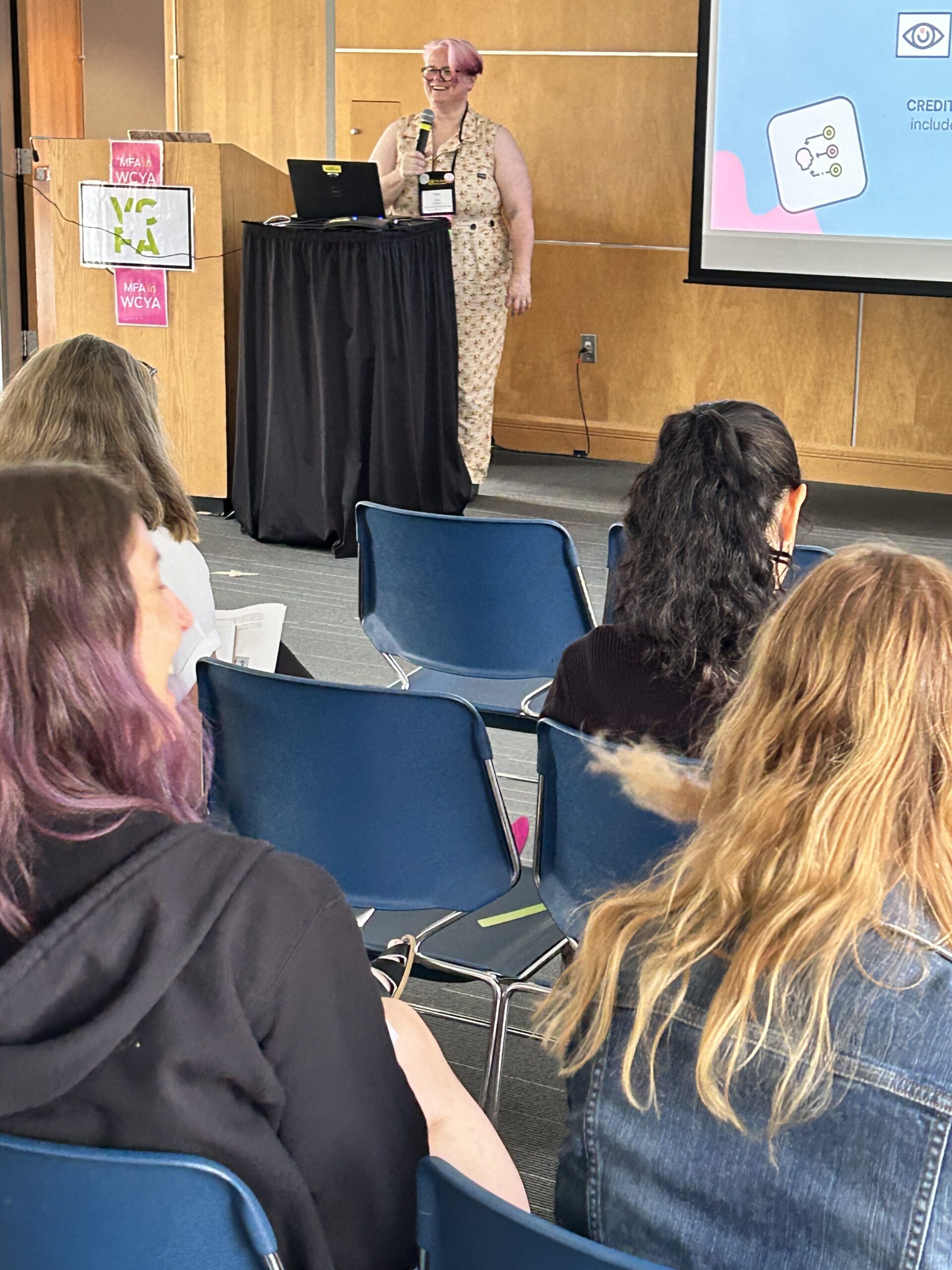
If William Gibson is speaking anywhere near you, I recommend you go. This is the second time I’ve seen him at Powell’s; here’s what I wrote about the other time.
This time Mr. Gibson was juxtaposed with a taxidermically-themed art exhibit, which made it appear among other things that a bear was enthusiastic and amused and a deer was pensively, almost sternly contemplating his words. This photo, which I did not take, gives you a bit of an idea of the effect:
One thing I always find slightly disconcerting at readings, and which was definitely in evidence at this one: people who follow along in the copies of the book from which the author is reading. To make sure the author isn’t deviating from the printed text? Because you like to look at words on a page while hearing them pronounced by the person who decided to put them in that particular order? If you do this, I would love to know your reasons.
I enjoyed the reading itself — selections from his essay collection, Distrust That Particular Flavor — but his answers to audience questions were especially good. Gibson is eloquent and funny even in his casual speech — although I suppose you could argue that any public speaking is by its nature not casual. But his nonchalant delivery makes his smart and well-turned phrases feel more off-the-cuff than they perhaps are, and the effect is extremely pleasant.
So mostly what I did was scribble quotes, or near-quotes.
About influences:
“Being human, you tell people you like who you think it’ll sound cool if you say you like.”
“As writers, how we learn what is good is from everything we read — a personal microculture of literature.”
“Someone setting out to write sf who has only ever read sf is at a certain disadvantage.”
I can’t remember what question this next bit was in response to — I think someone asked if he considered himself a watcher? (Were they thinking of Juvenal? Or Alan Moore?)
“…a watcher in the sense of an anthropologist without any of the discipline…also a flâneur, walking about pointlessly in large cities…”
Someone asked if the Blue Ant books were meant to remind us that we’re living in someone else’s future:
“I write novels to find questions, not because I know the answers…the only conscious purpose of the Blue Ant books was that I realized after All Tomorrow’s Parties that the yardstick I used for measuring cognitive dissonance on the page as opposed to the world outside was an eighties yardstick. So I wrote Pattern Recognition to update the yardstick.”
“Google Streetview changed how my imagination worked — you could spend the rest of your life describing a single block — inadequately.”
I wanted to ask him what he thinks about the way search tools are increasingly being designed to bring us the Internet they think we want, but I did not get a chance. Next time, Mr. Gibson.